New tool · Anthropic
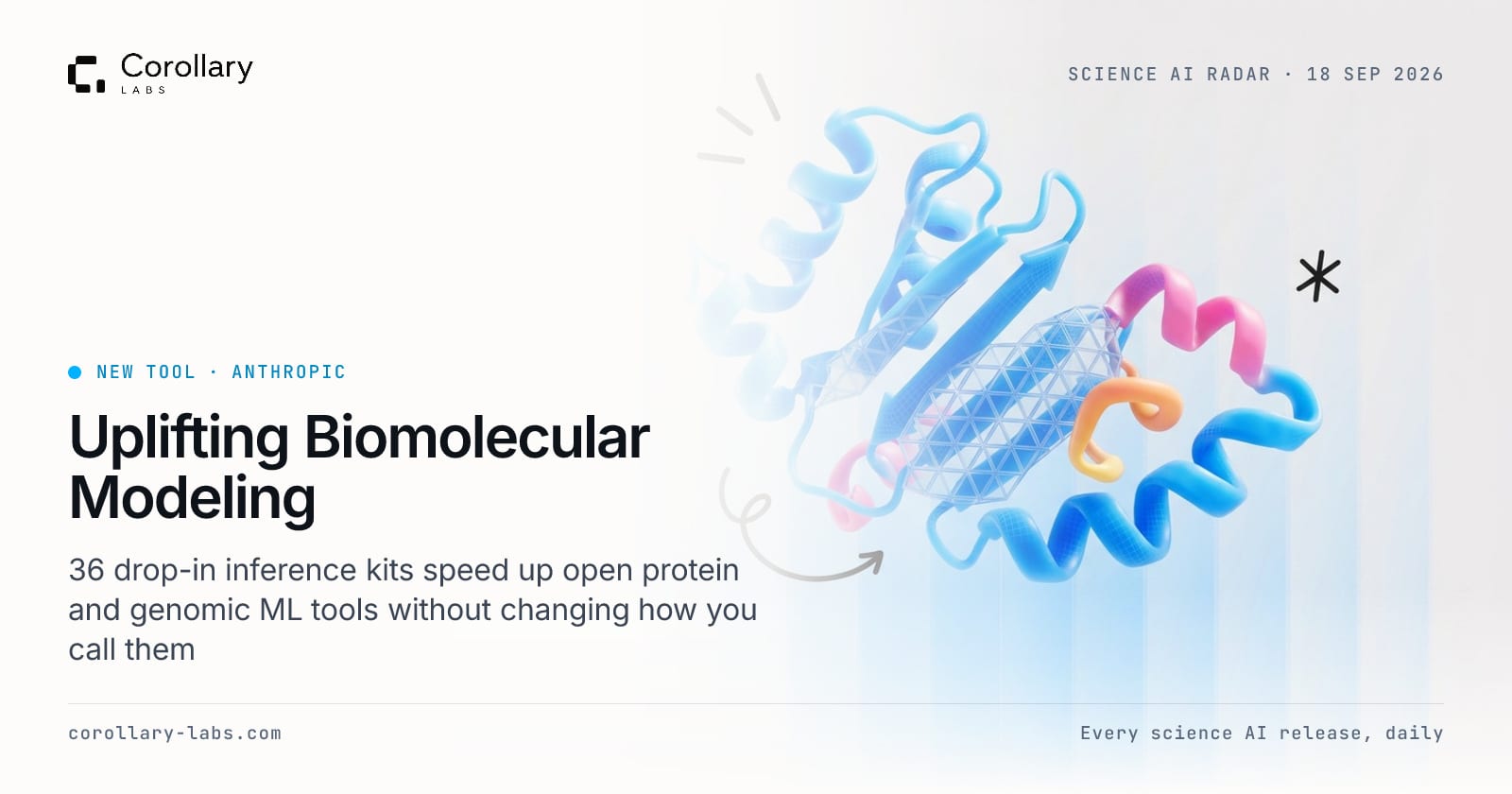
Uplifting Biomolecular Modeling
36 drop-in inference kits speed up open protein and genomic ML tools without changing how you call them
· 11 claims checked against 1 source
What it is
Uplifting Biomolecular Modeling is a reference release from Anthropic containing 36 drop-in inference-optimization kits for open protein and genomic machine learning tools. The kits cover structure prediction and cofolding (AlphaFold-family models such as openfold3, rosettafold3, protenix_v2), binder and sequence design (rfdiffusion3, boltzgen, proteinmpnn), and protein and genomic language models (esmc, enformer, evo2), among others.
How it works
Each kit pairs with a pinned copy of the upstream tool it accelerates, with weights checked by SHA-256 digest. The upstream tool is called exactly as before; a named mode engages the kit's optimizations at start-up. A shared runtime, common/opt_core, supplies GPU kernels including FlashPairformer and the triangle-attention and triangle-multiplication kernels used by the structure kits.
What is new
- 36 kits, one per upstream tool, each pinned to a specific upstream version
- Four modes across the set: off (unmodified stock), exact (identical outputs, faster), fast (small documented numeric differences, faster still), and big (lowest peak GPU memory, can split one prediction across multiple GPUs on a host)
- Every run prints an ACTIVE line naming what is engaged; a mode that cannot run on the machine exits with an error rather than silently falling back to stock
- The two foundry kits, rfdiffusion3 and rosettafold3, install via a file overlay into a separate interpreter, keeping a pristine interpreter available for off
Limits
This is a reference release accompanying Anthropic's blog post on the work. It is not maintained and does not accept pull requests, though forks are welcome. Prebuilt Docker and Apptainer images are planned within a week of the initial release; until they arrive, each kit must be built from its own Dockerfile.
Availability
Installation is available via Docker, Apptainer, or a plain Python virtual environment at pinned versions, depending on what each kit offers. The kit code and wrappers are licensed under the Apache License 2.0; each upstream tool kept in stock/ retains its own original licence.
The evidence
Each statement above was written with the sentence from the source that supports it, and a program (not a model) checked that every quote and every figure appears in the pages it read. Here they are.
- 01
The release contains 36 optimization kits for open protein- and genomics-ML tools covering structure prediction/cofolding, binder/sequence design, and protein and genomic language models.
“36 drop-in optimization kits for the inference paths of open protein- and genomics-ML tools: structure prediction and cofolding, binder and sequence design, protein and genomic language models” S1
- 02
Each kit ships modes named off, exact, fast, and big with defined behavior.
“exact — outputs identical to off, faster. fast — small, documented numeric differences (within the tool's own seed-to-seed variation), faster still.” S1
- 03
big mode gives lowest peak GPU memory and can split a prediction across multiple GPUs.
“big — lowest peak GPU memory, for inputs the other modes cannot hold. Where a kit ships it, --n_gpu P splits one big prediction across P GPUs of one host.” S1
- 04
Every run prints an ACTIVE line and a mode that cannot engage exits with an error rather than falling back silently.
“A kit never falls back to stock silently.” S1
- 05
The shared core provides FlashPairformer and triangle-attention/triangle-multiplication kernels used by structure kits.
“the shared GPU kernels (FlashPairformer and the triangle-attention / triangle-multiplication kernels the structure kits use)” S1
- 06
rfdiffusion3 and rosettafold3 install via a file overlay into a second interpreter, keeping a pristine interpreter for off.
“The two foundry kits (rfdiffusion3, rosettafold3) instead install a small file overlay into a second interpreter and keep a pristine interpreter for off.” S1
- 07
Weights are pinned and checked by digest.
“weights pinned by digest” S1
- 08
Installation can be done via Docker, Apptainer, or a Python venv.
“Get the kit's pinned stack in ONE of up to three ways (each kit's Setup shows which it offers): A — Docker: the kit's Docker image; B — Apptainer: an Apptainer image (.sif) converted from it; C — Python venv” S1
- 09
The kit code is licensed under Apache License 2.0, while upstream code in stock/ keeps its own licence.
“Licence: LICENSE (Apache License 2.0, for the original code) and NOTICE at the top of this tree; each kit's own LICENSE sets stock/ (the upstream project, under its own licence) apart.” S1
- 10
This is a reference release accompanying an Anthropic blog post; it is not maintained and does not accept pull requests.
“This is a reference release that accompanies the "How Claude is uplifting biomolecular modeling" blog post. The code is provided as-is at the upstream versions pinned in each kit's STOCK.md; Anthropic does not plan further updates and does not accept pull requests.” S1
- 11
Prebuilt Docker and Apptainer images are planned within a week of the initial release.
“Prebuilt Docker and Apptainer images, with each kit and its dependencies already installed, are planned within a week of this initial release.” S1